

You have a fixed marketing budget and a board expecting growth. Spending too much on one channel is risky. Spreading too thin produces nothing. Most startups get digital advertising budget allocation wrong because they follow playbooks designed for companies with ten times their spend.
This post outlines how to allocate your ad budget so every dollar drives measurable results.
The Default Allocation Is Usually Wrong
Most startups default to putting 70-80% of budget into Google and Meta. That split made sense five years ago. It does not make sense now. Google Search CPCs in competitive SaaS categories have risen 15-20% year over year. Meta’s cost per lead climbs as more advertisers fight for limited inventory.
The mistake is not using these platforms. The mistake is over-indexing on them before testing whether cheaper alternatives produce the same results.
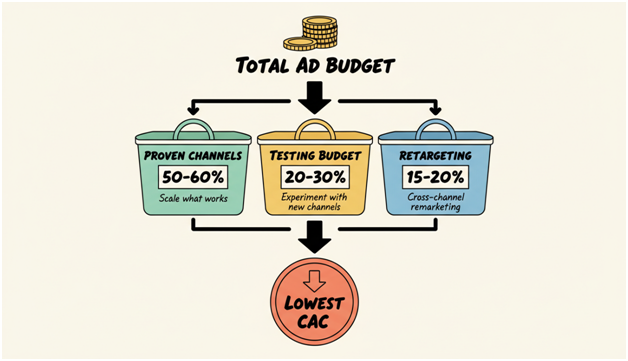
The best budget allocation is not about picking the biggest channel. It is about finding the cheapest path to a qualified customer.
A Framework for Smart Budget Allocation
Forget percentage-based rules. Allocate based on evidence. Here is what to evaluate for each channel.
Cost Per Qualified Lead
Clicks and impressions do not pay the bills. Measure what you actually pay for a lead that your sales team can work. A channel with high CPMs but low cost-per-qualified-lead beats a cheap channel that delivers junk. Track this metric for every platform, including community channels where you advertise on reddit and similar platforms with engaged audiences.
Time to First Conversion
Some channels produce results in days. Others need weeks of audience building. Your budget allocation should account for velocity. If you need pipeline this quarter, weight toward channels with faster feedback loops. If you are building for next quarter, invest in channels that take longer but produce higher lifetime value.
Audience Overlap Analysis
Running Google, Meta, and LinkedIn simultaneously often means you pay to reach the same person three times. Use audience overlap reports to identify redundancy. Then shift budget from overlapping channels to platforms that reach net-new prospects.
Scalability Ceiling
Every channel has a point where adding more budget produces diminishing returns. A niche subreddit might deliver incredible results at $5,000 per month but cannot absorb $50,000. Factor in each channel’s ceiling when planning your allocation. Diversification protects you when one channel maxes out.
Attribution Clarity
Give more budget to channels where you can clearly track the path from ad click to closed deal. Murky attribution makes optimization impossible. Platforms with strong conversion APIs and pixel support let you see exactly what your money buys.
Practical Allocation Steps
Here is how to build your allocation from scratch.
Audit your current spend. Pull cost-per-qualified-lead for every active channel. Rank them. The bottom 20% of performers should lose budget immediately.
Reserve 15% for testing. This is non-negotiable. Testing new channels is how you find the arbitrage opportunities that drop your blended CAC. Platforms where startups advertise on reddit are often discovered through these test budgets before becoming core channels.
Split remaining budget by funnel stage. Allocate roughly 40% to bottom-funnel conversion campaigns, 35% to mid-funnel consideration, and 25% to top-funnel awareness. Adjust based on your sales cycle length. Longer cycles need more mid-funnel investment.
Rebalance monthly. Static budgets waste money. Review performance every 30 days and shift dollars from underperforming channels to outperforming ones. Small, frequent adjustments beat quarterly overhauls.
Account for creative costs. A channel that needs $3,000 in video production per month eats into your effective budget. Factor production costs into your true cost-per-lead calculation. Channels with simpler creative requirements stretch your budget further.
What Happens When You Get This Right
Startups that allocate budget based on evidence instead of convention see measurable improvements. Their blended CAC drops because they stop overpaying for leads on crowded platforms. Their pipeline diversifies because they are not dependent on two channels.
The startups that keep dumping 80% into Google and Meta will keep seeing rising costs and tighter margins. Budget allocation is not a set-it-and-forget-it decision. It is a competitive advantage you build through continuous testing and honest performance measurement.
Start with the data you have. Test with the budget you can spare. Reallocate based on what works.